How to understand your triggers | Naming the feeling | Interview with Kathryn Paige Harden ͏ ͏ ͏ ͏ ͏ ͏ ͏ ͏ ͏ ͏ ͏ ͏ ͏ ͏ ͏ ͏ ͏ ͏ ͏ ͏ ͏ ͏ ͏ ͏ ͏ ͏ ͏ ͏ ͏ ͏ ͏ ͏ ͏ ͏ ͏ ͏ ͏ ͏ ͏ ͏ ͏ ͏ ͏ ͏ ͏ ͏ ͏ ͏ ͏ ͏ ͏ ͏ ͏ ͏ ͏ ͏ ͏ ͏ ͏ ͏ ͏ ͏ ͏ ͏ ͏ ͏ ͏ ͏ ͏ ͏ ͏ ͏ ͏ ͏ ͏ ͏ ͏ ͏ ͏ ͏ ͏ ͏ ͏ ͏ ͏ ͏ ͏ ͏ ͏ ͏ ͏ ͏ ͏ ͏ ͏ ͏ ͏ ͏ ͏ ͏ ͏ ͏ ͏ ͏ ͏ ͏ ͏ ͏ ͏ ͏ ͏ ͏ ͏ ͏ ͏ ͏ ͏ ͏ ͏ ͏ ͏ ͏ ͏ ͏ ͏ ͏ ͏ ͏ ͏ ͏ ͏ ͏ ͏ ͏ ͏ ͏ ͏ ͏ ͏ ͏ ͏ ͏ ͏ ͏ ͏ ͏ ͏ ͏ ͏ ͏
August 20th, 2026
_A newsletter by_ Anne-Laure Le Cunff

Hi friends,
A couple of days ago, I was having coffee with a good friend who was telling me about some difficult feedback she had received at work on a project, how much it had affected her emotionally, and how she wished she could be more “chill” about it.
I told her I didn’t think she should try to be chill, as there was actually so much she could learn from that emotional response if she approached it like a scientist: with curiosity rather than self-blame.
This week, I want to explore three simple steps you can use to practice emotional inquiry whenever you notice yourself having a strong reaction. I hope you find them helpful.
And don’t forget to check out all the amazing upcoming events in the community at the bottom of the newsletter!
— Anne-Laure
When I had just started at Google, I raised my hand to take on a research project that was particularly scary to me, as it would be used by our partners team to make real-world decisions. The question was: why weren’t brands taking YouTube seriously, and what might convince them of the value of online video?
I know this feels obvious today, but at the time TV was still the gold standard for reaching mass audiences, and the idea of a “content creator” had barely entered the mainstream.
So, on top of my other projects, I spent hours reading about digital advertising, consumer psychology, and media strategy. I really wanted to get it right.
When I finally presented my findings, a colleague pointed out a few weaknesses in my methodology. I became so emotional that I left the call and pretended I was having internet problems. Then, in my head, that feedback quickly ballooned into doubts about whether I was cut out for a job at Google at all.
It might not feel so salient, but most of us have experienced a version of this. A colleague gives you a piece of feedback which you know isn’t particularly harsh, but you keep replaying it for the rest of the day, or the week.
That’s because we often assume that our immediate emotional responses are a direct reflection of what happened. But the event is only part of the story. Studies suggest that what also matters is what that event means to us.
Organizational psychologist Marcia Reynolds has written about the psychological needs that can underlie emotional triggers. Constructive feedback might feel threatening if being seen as competent matters deeply to you. An unexpected change might unsettle you if you value predictability. Being left out might threaten your sense of inclusion. A dismissive comment might feel especially charged when respect is especially important to you.
That doesn’t mean every emotion is revealing some profound hidden truth, but strong reactions can be useful clues.
So instead of asking, “Why am I so upset about this?”, try asking, “What feels threatened here? This shift will help you separate the trigger from the need. For instance:
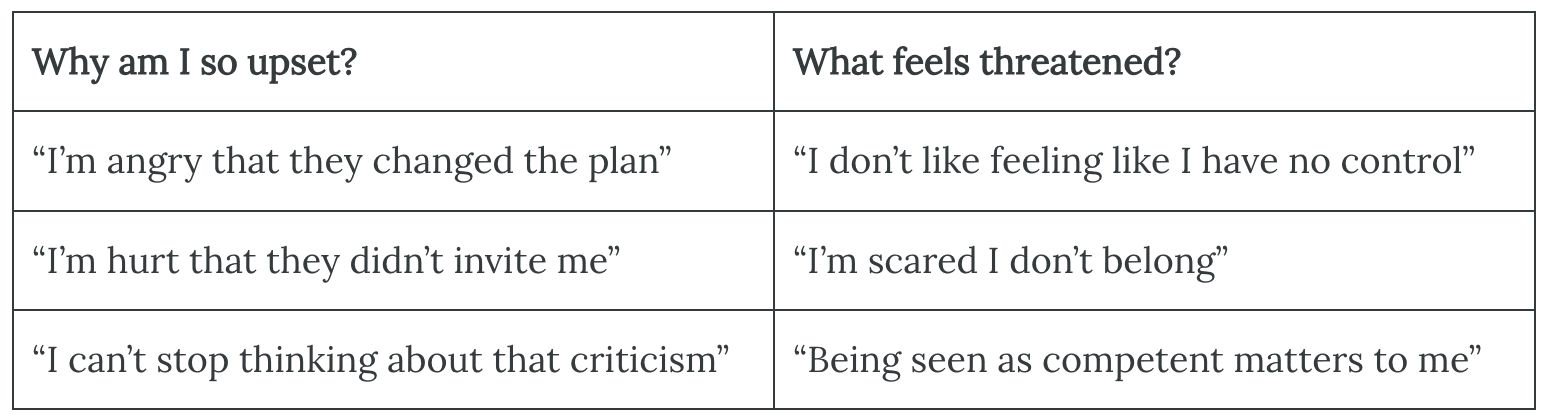
Emotional inquiry examples
Once you know what the emotion may be pointing toward, you have more options. You can decide whether the need is genuinely being threatened, whether your interpretation is accurate, and what (if anything) you want to do about it.
Here’s a simple way to practice emotional inquiry:
Name what you’re feeling. Get more specific than “bad” or “stressed.” Is it disappointment, embarrassment, resentment, anxiety? Research shows that the emotion can make it easier to observe rather than immediately act on.
Explore what feels threatened. Look underneath the immediate trigger. Are you wanting more certainty, autonomy, respect, belonging, fairness, or recognition?
Then decide what the situation actually requires. Sometimes you need to speak up. Sometimes you need more information to understand the criticism. And sometimes you simply need twenty minutes before replying to that email.
The idea here isn’t to obey every emotion or to eliminate uncomfortable ones, but simply to become better at interpreting them. Name what you feel, explore what feels threatened, and then only choose what the situation actually requires.
Sometimes the emotion will point to something you need to address. Other times, you may realize that the threat exists mostly in your interpretation of what happened. Either way, you’re in a better position to decide what to do next.
Every emotion is a signal. So, instead of judging yourself for having a strong reaction, a more useful question is to ask what exactly it is signaling.
Flowing is a desktop writing application for researchers and students who want AI assistance without losing touch with their sources. In this interview with its founder Jim Lau, we talked about how writing is a form of thinking, the importance of context, the challenge of resurfacing what we already know, how trust is based on traceability, and much more. Enjoy the read!
Try this week’s tiny experiment to better understand your responses and the triggers underneath:
I will [practice emotional inquiry] for [1 week].
You can go through the name - explore - decide steps above, and even take a few notes in your journal so you can revisit this trigger later on and compare your responses.
Want to learn how to run tiny experiments in all areas of your life and work? Get your copy of Tiny Experiments.
• You have 80,000 hours in your career. Most career advice relies on platitudes, not evidence. 80,000 Hours offers a practical, research-backed guide to what makes a fulfilling job, which skills matter in the age of AI, and how to find work that makes a difference. Get your free copy now.
• Deeper than a summary. Faster than a book. Your reading list keeps growing. Your free time doesn’t. Learn the key ideas, context, and practical takeaways from bestselling nonfiction—in about 20 minutes. Expert guides. Practical exercises. Insights you can actually use. Start free.
• Become a scientist of your own anxiety. Rewire Anxiety is a 15-day challenge from Jonny Miller, creator of Nervous System Mastery. Try one somatic protocol each day, from breathwork to worry mapping to non-sleep deep rest, notice what shifts in your body, and practice alongside a group doing the same. Begins September 1st. Join the challenge.
Many thanks to our sponsors and cross-promo partners for supporting the Ness Labs newsletter! Want to appear here? Please email support@nesslabs.com to learn more.

KATHRYN PAIGE HARDEN
Each week I ask a curious mind about their habits, routines, and rituals. This week we learn from acclaimed psychologist Kathryn Paige Harden, whose book Original Sin explores how genetics complicates our ideas about moral responsibility.
1. One daily practice you can’t do without? Walking on the greenbelt trails near my home. Thinking feels different when my body is moving through physical space. One hour of walking makes all the other hours of my day better.
2. One idea that keeps you up at night? We’ve known for decades that antisocial behavior is just as heritable as depression or body weight. But we’ve devoted few scientific resources to understanding its biology or developing new interventions to change it.
3. One mindset shift that transformed your work? My relationship to praise. Early in my career, I treated positive feedback as a reliable signal that I was producing good work. Now, the reward of work is increasingly the work itself – the opportunity to think deeply about questions I find compelling.
If you enjoy the newsletter, you’ll love our community of curious minds conducting tiny experiments within a safe space and learning together. Here is an overview of upcoming events (full calendar):
• Discover the neuroscience of hope. Join William Collins for a workshop where you will learn how to understand your mind frames, how they impact your relationship with the future, and how to reframe them.**
All of these and future events are included in the price of the membership (only $49 for one year), as well as access to our courses, workshop library, and a dedicated space to track your tiny experiments.
Until next week, take care!
Anne-Laure.
You received this email because you subscribed to the Ness Labs newsletter. “-ness” is a suffix that means “state of being”, as in aware_ness_, mindful_ness_, conscious_ness_. Ness Labs is a playground for curiosity – a place where you can learn how to experiment with ideas, explore creative projects, and reflect on your progress. Of course I don’t want to see you go, but you can unsubscribe at any time. If you do leave, I’d love an email to let me know what I could do better to improve the newsletter. Alternatively, you can update your profile to use a different email address. © Ness Labs, 600 1st Ave, Ste 330 PMB 92768, Seattle, WA 98104-2246.

